
Plants
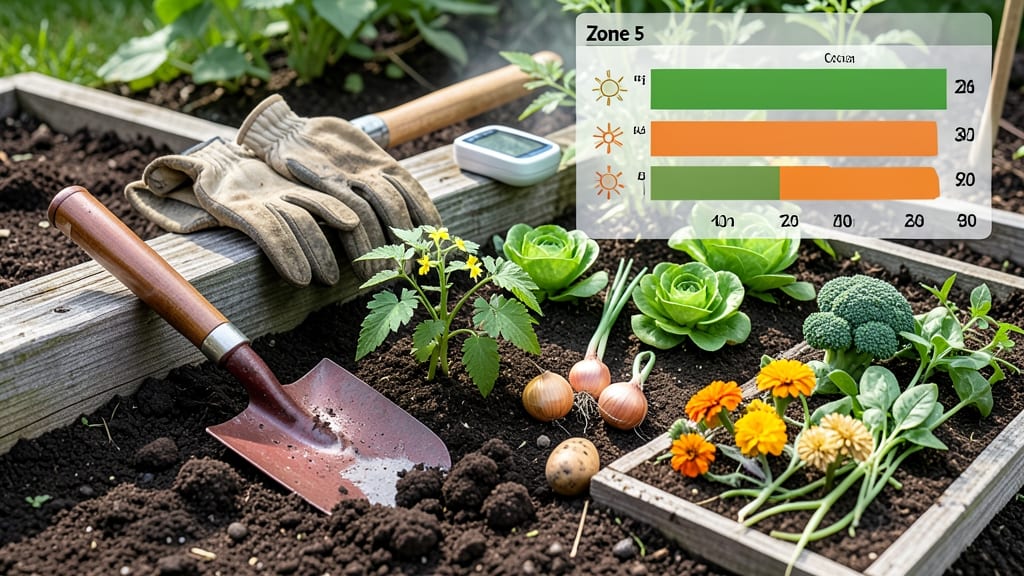
To plant in Zone 5, time your crops around frost dates: sow cool-season vegetables like spinach and peas 4-6 weeks before your last spring frost (usually mid-April), and plant warm-season favorites such as tomatoes and peppers 2-3 weeks after the last frost (typically late May). Always verify local frost averages and account for microclimates.
Timing your garden in Zone 5 means working with the region's average last frost dates, which can shift slightly depending on elevation and local weather patterns. 🌱 For example, valleys often warm up faster than hilltops, so I always check both the USDA hardiness zone map and my county's historical frost records—this helps me fine-tune planting for my specific yard.
The key is balancing soil temperature (which warms more slowly than air) with air temperature trends, especially for heat-sensitive crops like lettuce or basil.
Pro tip: Use frost-free date calculators from your local cooperative extension office—they factor in 10-year averages and give you a more reliable timeline than generic zone guides. I've learned that even a week's difference can mean the difference between thriving seedlings and stunted growth.
💡 In This Article
- Zone 5 Frost Dates and Their Impact on Planting
- Crop-Specific Planting Schedule for Zone 5 Gardens
Zone 5 frost dates and their impact on planting
The science behind frost timing in Zone 5 revolves around two critical data points: the average last spring frost and the average first fall frost.
These dates aren't arbitrary—they're calculated using 30-year climate averages, with the USDA defining Zone 5 as areas where temperatures dip to -15°F to -20°F in winter. However, what matters most for planting is the soil temperature, not just air temperature.
Soil stays cooler and warms more slowly, which is why you can't rely solely on air thermometers. For example, while the air might hit 50°F in early April, the soil may still be hovering around 40°F, delaying planting for heat-loving crops.
Local microclimates create even more variation.
A south-facing slope might warm 1-2 weeks earlier than a north-facing area, while urban heat islands can push frost dates back by 5-7 days compared to rural zones. 🌿 To account for this, I always cross-reference the USDA map with my county's historical frost records—available for free from the National Oceanic and Atmospheric Administration (NOAA).
For instance, in central Ohio (Zone 5b), the last frost typically occurs around April 15th, but in western Pennsylvania (Zone 5a), it can linger until May 1st. This 16-day difference is huge for crops like tomatoes that need consistent warmth.
Soil temperature is particularly critical because seeds and seedlings have specific thresholds for germination. Cool-season crops like broccoli and kale can handle soil temps as low as 40°F, while warm-season crops like cucumbers and squash won't germinate below 60°F.
This is why I use a soil thermometer—it tells me when the ground is truly ready. For example, planting beans in 55°F soil might work, but they'll germinate faster and stronger in 65°F soil.
The difference between these temperatures can mean the difference between a thriving crop and one that struggles to establish itself.
Another layer to consider is the 32°F threshold—the temperature at which water freezes and can damage tender plants. Most Zone 5 gardeners use this as their cutoff for transplanting frost-sensitive crops.
However, what's less obvious is how radiation frost (frost that forms on clear, calm nights) can occur even when the air temperature stays above freezing. This is why I always have frost cloth on hand for late spring nights, especially when planting warm-season crops like peppers in early May.
For fall planting, the first frost date becomes your deadline for harvesting or protecting tender crops. In Zone 5, this typically falls between October 15th and November 1st, depending on location. But here's the catch: some crops, like kale and Brussels sprouts, actually sweeten after a light frost.
This is because the plant converts starches to sugars as a survival mechanism—a natural process called vernalization. Meanwhile, crops like basil and tomatoes won't survive even a light frost, so I always have my row covers ready to extend the season by 2-4 weeks.
To make this concrete, here's how I plan my year: I start cool-season crops in early March under row covers, transplant frost-hardy greens by mid-April, and wait until late May for tomatoes.
For fall, I direct-sow spinach in early August and protect it until the first frost. This schedule gives me a 10-month growing season instead of just 6 months, maximizing my garden's potential. 🌱