
Companion Plants
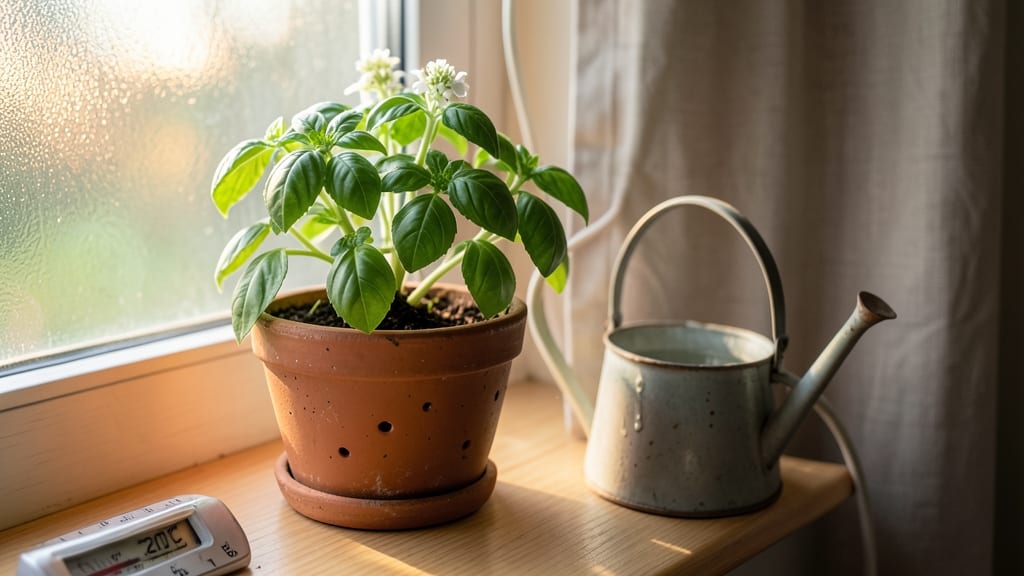
Yes, you can bring your basil plant indoors for winter with the right conditions: place it near a sunny window, use grow lights for 12-14 hours daily, and adjust watering to prevent over-saturation while keeping humidity above 40%. Gradual temperature changes help maintain its health.
Basil thrives in warmth and sunlight, so indoor survival depends on replicating its natural growing conditions. 🌱 The key challenge is light deprivation—without enough brightness, your plant will stretch toward any available source, producing weak stems and pale leaves.
I've found that supplementing with full-spectrum LED grow lights (especially those with blue wavelengths) can mimic outdoor sunlight effectively.
Another critical factor is humidity; indoor heating often dries the air, so placing your basil on a pebble tray with water or using a small humidifier nearby can prevent leaf browning and wilting.
When transitioning your basil indoors, do it gradually over 7-10 days to avoid shocking the plant. Start by moving it to a shaded outdoor spot during the day, then bring it inside at night. This slow adaptation helps the leaves adjust to lower light levels.
Once inside, prune any yellowing or damaged leaves immediately to redirect the plant's energy toward new growth. With these adjustments, many basil plants can survive—and even produce new leaves—through the winter months.
💡 In This Article
- Indoor Light Requirements for Basil Plants in Winter
- Step-by-Step Guide to Transitioning Basil Indoors
Indoor light requirements for basil plants in winter
Basil plants rely on bright light for photosynthesis, a process that converts sunlight into energy through chlorophyll in the leaves. In winter, indoor light levels drop dramatically—natural sunlight provides only about 10-20% of the intensity compared to summer conditions.
Without sufficient light, basil plants struggle to produce enough energy, leading to weak stems and poor leaf development. The ideal light spectrum for basil includes blue wavelengths (400-500nm), which promote compact growth and vibrant green leaves, while red wavelengths (600-700nm) drive flowering and seed production.
You can spot insufficient light through visual cues: leggy stems that stretch toward the light source, pale or yellowing leaves, and reduced leaf size.
These are clear signs your basil isn't getting enough energy. 🌿 A south-facing window typically provides the brightest natural light indoors, but even this often falls short during winter months. If your basil is more than 12 inches away from the window, it's likely not receiving enough light.
Grow lights with a 12-14 hour photoperiod can bridge the gap, mimicking natural daylight cycles and preventing the plant from entering a dormant state too early.
The science behind grow lights is fascinating: full-spectrum LEDs replicate sunlight's natural balance, while cheaper white LEDs may lack the necessary blue and red ratios.
For example, a 6000K LED bulb (cool white) provides more blue light, which is ideal for leafy growth, whereas a 3000K bulb (warm white) skews more toward red.
Position the grow light 6-12 inches above the plant and adjust the height as the basil grows to maintain optimal light exposure without burning the leaves.
Another critical factor is the angle of light exposure. Basil plants need light from multiple directions to prevent one-sided growth, which can cause the plant to lean. Rotate your basil pot quarter-turns every few days to ensure even light distribution. This simple step helps maintain a bushy, healthy plant structure.
If you notice the leaves turning toward the light source, it's a clear signal that your basil is searching for more energy—time to supplement with a grow light or move it closer to the window.
For those without grow lights, consider placing your basil on a sunny windowsill with a reflective surface (like aluminum foil) underneath the pot. This trick bounces extra light upward, increasing the plant's exposure by up to 30%**.
However, even with these adjustments, basil plants indoors may grow more slowly during winter, so patience and consistent care are key.